What you need to know now about the best places to live in Pennsylvania:
- York, Cumberland, Lancaster, and Adams Counties each offer a genuinely different version of “best,” depending on your commute, your budget, and how much land you actually want.
- Cumberland County is growing faster than almost anywhere else in the state, while York and Adams stay more affordable per square foot.
- Water, septic, and zoning rules shift from township to township inside all four counties, not just from county to county.
- Home values here still sit well below many parts of the Northeast and mid-Atlantic, even as Central Pennsylvania keeps pulling in new residents.
Keep reading to see exactly how these four counties stack up, and which one actually fits your plans.
What Are The Best Places To Live In Pennsylvania Right Now?
There isn’t one best place to live in Pennsylvania. There are four strong, very different counties in the Susquehanna Valley, and the right one depends on what you’re actually optimizing for.
York, Cumberland, Lancaster, and Adams Counties make up the core of Central Pennsylvania’s growth story in 2027. Each one pulls a different kind of buyer for a different reason.
York County draws people who want small-city convenience without big-city prices. Cumberland County draws commuters and families chasing Harrisburg-area jobs. Lancaster County draws buyers who want farmland views and a real downtown. Adams County draws people who want space, history, and room to build.
We build across all four of these counties, and the right fit really does change from one township to the next. See the exact communities where our crews are already working. Explore Our Service Areas →
How Do York, Cumberland, Lancaster, And Adams Counties Compare?

Side by side, these four counties split into two groups: Lancaster and Cumberland run higher on income and home value, while York and Adams stay more affordable with slightly longer commutes in Adams’s case.
The numbers below come straight from the U.S. Census Bureau’s County QuickFacts and show just how differently these counties are growing.
| County | 2020 Census Population | Population Growth, 2020-2025 | Median Home Value | Median Household Income |
|---|---|---|---|---|
| York County | 456,438 | +3.7% | $248,600 | $84,829 |
| Cumberland County | 259,469 | +6.9% | $261,900 | $85,634 |
| Lancaster County | 552,984 | +1.8% | $301,100 | $86,959 |
| Adams County | 103,852 | +3.6% | $256,100 | $81,071 |
Lancaster carries the highest home values of the four, which tracks with its larger population and tighter farmland supply.
Cumberland is the real outlier on growth. Its population jumped nearly four times faster than Lancaster’s between 2020 and 2025.
These figures are county-wide estimates from public data, not a quote for any specific property. Prices for an individual lot or home still depend on the township, the utilities, and the condition of the land itself.
What Is It Like To Live In York County, PA?
York County works best for buyers who want borough-style walkability in small towns, paired with a short drive into bigger job centers like Harrisburg, Baltimore, or Lancaster.
The county stretches from the city of York itself out to dozens of smaller boroughs and townships, each with its own character.
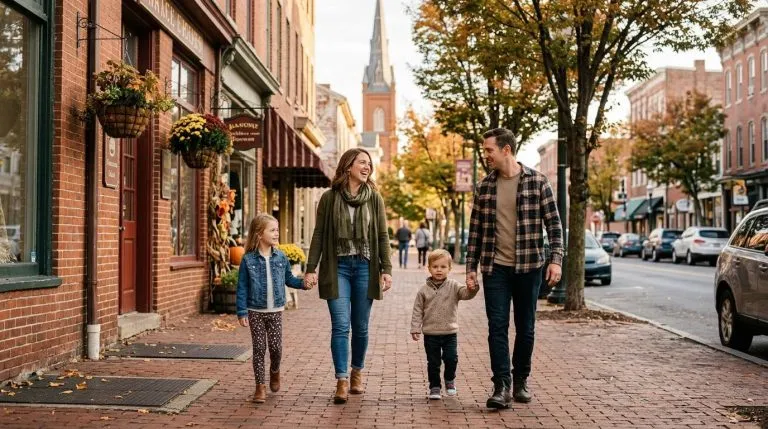
Family walking through downtown York, Pennsylvania on a fall afternoon
Towns worth knowing in York County include:
- York
- Dallastown
- Delta
- New Freedom
- Stewartstown
- Shrewsbury
- Lewisberry
- Manchester
- Newberrytown
- Dover
- Hanover
- Spring Grove
- Seven Valleys
- Dillsburg
Shrewsbury, New Freedom, and Stewartstown sit along the Mason-Dixon line, close enough to Baltimore for a daily commute. Dillsburg and Lewisberry lean north toward Harrisburg instead.
York County’s median home value runs lower than Lancaster’s and Cumberland’s, which is part of why it keeps showing up on relocation lists for people leaving more expensive metro areas.
York County’s small boroughs carry more weight in this decision than most people expect. We walked through what daily life actually looks like here, town by town. Read: Living in York, PA →
What Is It Like To Live In Cumberland County, PA?
Cumberland County is the fastest-growing county in Central Pennsylvania, driven by its position along I-81 and its direct access to Harrisburg’s job market.
According to Penn State’s Pennsylvania Office of Rural Health, Cumberland County’s population grew 6.9 percent between 2020 and 2025, the second-fastest rate of any county in the state.
Towns worth knowing in Cumberland County include:
- Mechanicsburg
- Camp Hill
- New Cumberland
- Lemoyne
- Lower Allen
- Upper Allen
Camp Hill and Lemoyne sit right across the Susquehanna River from Harrisburg, which keeps commute times short for anyone working downtown. Mechanicsburg and the Allen townships offer more room to build further from the river.
That growth hasn’t pushed Cumberland’s home values far past York County’s, which is unusual for a county expanding this fast. Builders and buyers both notice the gap.
What Is It Like To Live In Lancaster County, PA?
Lancaster County is where farmland, Amish country, and a genuine small-city downtown meet, and it draws buyers who want character over speed.
It’s the most populous of the four counties by a wide margin, and according to the Census Bureau’s figures for Lancaster County, its population passed 563,000 in 2025, pushing home values well above the other three counties.
Towns worth knowing in Lancaster County include:
- Columbia
- Mt Joy
- Elizabethtown
- Marietta
- Lancaster
- Millersville
- Lititz
- Manheim
Lititz and Manheim sit north of the city and tend to draw families looking for smaller-town schools. Columbia and Marietta, both along the Susquehanna River, pull a different crowd interested in river access and historic architecture.
Lancaster’s farmland and small-city core pull in a very different kind of buyer than York does. We broke down exactly who tends to thrive here. Read: Is Lancaster, PA a Good Place to Live? →
What Is It Like To Live In Adams County, PA?
Adams County is the most rural of the four, built around Gettysburg’s history and some of the most open land left in the region.
It’s also the smallest county here by population, which means more room between neighbors and more land available to build on.
Towns worth knowing in Adams County include:
- New Oxford
- Littlestown
- Abbottstown
- East Berlin
- Gettysburg
- Fairfield
Gettysburg itself carries real weight beyond the battlefield. The historic district draws steady tourism, and the surrounding townships still have working orchards and farmland within a short drive of town.
New Oxford and East Berlin sit closer to the York County line, which puts them within easy reach of York’s job market without Adams’s slower pace of growth.
Adams County’s commute times run longer than the other three counties, which tracks with how spread out the townships are.
What Else Should You Know Before You Choose A County?

Beyond population and price, the details that actually affect a future homeowner come down to utilities, zoning, and how fast home values are climbing in each county.
Realtor.com listing data compiled by the Federal Reserve Bank of St. Louis shows Cumberland and Adams Counties both climbing well past $420,000 in median listing price by mid-2026, up from roughly $260,000 in early 2020.
| County | Typical Water & Sewer | Zoning Authority | Land Character |
|---|---|---|---|
| York County | Public utilities in boroughs like York and Dallastown; well and septic common elsewhere | Set township by township, not county-wide | Rolling farmland blending into suburban lots near the city |
| Cumberland County | Strong public utility coverage along the Route 11 and I-81 corridor | Township zoning, generally development-friendly | Flatter valley terrain with fast-growing suburban tracts |
| Lancaster County | Borough utilities mixed with widespread private well and septic in farm country | Township zoning, often protective of preserved farmland | Rich agricultural land, with more lot restrictions near preserved ground |
| Adams County | Public utilities concentrated around Gettysburg and New Oxford; well and septic standard elsewhere | Township zoning, with historic district rules near the battlefield | Wooded and rural, with more large-acreage lots available |
None of these counties zone at the county level. Every township sets its own minimum lot size, setbacks, and well and septic requirements, which matters more than most buyers expect once they’ve picked a specific parcel.
Listing prices climbing this fast is part of why buyers who already own land, or who are actively looking for it, tend to move faster than people still deciding between counties.
What Should You Look For When You’re Ready To Build Here?

Once you’ve settled on a county, the next question is finding a builder who actually understands that county’s land, not just its zip code.
Look for a builder with real completed projects in the specific county you’re considering, not just a service area listed on a website.
Custom home with a covered porch on a wooded lot in Adams County, Pennsylvania
A few things worth asking before you sign anything:
- Have they built in this specific county before, and can they show you finished homes here
- Do they understand well and septic requirements for the township you’re looking at
- Is their quote fixed-price, or does it leave room to grow once construction starts
- Can they walk you through how local zoning and permitting actually works here
Once you’ve picked a county, the next decision is what actually gets built on that land. Browse the floor plans and finishes homeowners across these counties have already chosen. See Our Custom Homes →
What Should You Do Next If You’re Moving To Central Pennsylvania?
If you’ve narrowed things down to one or two counties, the next step is pairing that decision with an actual piece of land.
Drive the townships you’re considering at different times of day. A commute that looks fine on a map can feel very different at 7:30 on a Monday morning.
If you already own land, get it evaluated for septic and well feasibility before you fall in love with a floor plan. That one step avoids most of the budget surprises that come later.
If you don’t own land yet, talk to a local builder about what’s actually available in your target townships before you commit to a county on paper alone.
Frequently Asked Questions About The Best Places To Live In Pennsylvania
Is It Cheaper To Live In York County Or Lancaster County?
York County is generally cheaper. Its median home value runs about $52,000 below Lancaster County’s, and its median household income is lower too, so the overall cost of living tracks lower across the board. Lancaster’s higher values come from stronger demand for its farmland and its larger, more established downtown core.
Which Of These Four Counties Has The Shortest Commute To Harrisburg?
Cumberland County has the shortest average commute of the four, at 22.1 minutes, largely because so much of the county sits directly across the river from Harrisburg. York and Lancaster Counties both run slightly longer, and Adams County has the longest average commute at 28.6 minutes due to its more spread-out, rural layout.
Is Cumberland County A Good Fit For A Family Moving To Pennsylvania?
It can be a strong fit, particularly for families prioritizing schools and a shorter commute. Cumberland County has the highest rate of bachelor’s degree attainment among the four counties, and its fast growth has brought newer schools and infrastructure along with it. The tradeoff is less rural land compared to Adams or western Lancaster County.
Do I Need To Already Own Land Before I Decide Which County To Build In?
No, but it helps narrow the decision fast. Many buyers pick a general county first based on commute and budget, then work with a local builder to evaluate specific parcels for septic feasibility, zoning, and slope. What you shouldn’t do is fall in love with a floor plan before checking what a given township will actually allow on that lot.
Which County Has The Most Rural Land With No HOA Restrictions?
Adams County generally offers the most large-acreage, HOA-free land of the four, particularly in the townships surrounding Gettysburg and toward Fairfield. Western Lancaster County and the outer edges of York County also have rural stretches, though preserved farmland in Lancaster can come with its own use restrictions separate from a standard HOA.
Your Next Chapter Starts In One Of These Four Counties
York, Cumberland, Lancaster, and Adams Counties each solve a different problem for a different kind of buyer, and none of them is objectively the best place to live in Pennsylvania.
What matters is matching your actual priorities, commute, budget, land, and pace of growth, to the county that fits them, not the one that ranks highest on a generic list.
We’ve built homes across York, Adams, and Lancaster Counties, and we know the difference a specific township makes before a single stake goes in the ground. Bring us your county, your list, and your questions. Contact Us →


